
 By
By A worker lifts a large engine part with ease. His back is not painful. His arms are still. His shoulders and legs are draped over a metal frame that silently carries the weight for him.
It’s an industrial exoskeleton. It seems like something out of a sci-fi movie, yet it’s already on factory floors, construction sites, and warehouses.
As workplaces move toward automation and ever more intensive production targets, human labor still matters. They are not replacing these exoskeletons. Engineers are enhancing their power, safety, and durability, enabling them to operate for extended periods without damage.
This shift is also changing what mechanical engineering students need to know. For many students, the journey begins with a straightforward search: a list of universities in Raipur, Chhattisgarh, that provide quality education in modern manufacturing and robotics.
This is how exoskeletons are transforming the future of mechanical engineering.
What is an industrial exoskeleton?
An industrial exoskeleton is a wearable frame that helps the human body with manual tasks. It takes the strain off the muscles and joints, particularly for repetitive lifting or overhead labor.
There are two fundamental types of industrial exoskeletons.
- Passive exoskeletons are powered by mechanical support and springs and do not require motors.
- Active exoskeletons use motors and sensors to actively assist with mobility.
They are both trying to perform the same basic thing. They allow workers to do intense physical tasks with less fatigue and fewer injuries.
Industrial Exoskeleton Types and Their Applications |
|||
|---|---|---|---|
| Exoskeleton Type | How It Works | Typical Application | Benefit |
| Passive Exoskeleton | Uses springs, mechanical structures or stored energy without motors | Repetitive lifting and overhead work | Reduces muscle and joint strain |
| Active Exoskeleton | Uses motors, sensors and control systems to provide powered assistance | Heavy-duty industrial tasks | Provides greater physical assistance |
| Back-Support Exoskeleton | Supports the lower back during bending and lifting | Warehouses and manufacturing | Helps reduce back fatigue |
| Shoulder/Upper-Body Exoskeleton | Supports the arms during elevated work | Automotive and aerospace assembly | Reduces shoulder strain |
| Lower-Body Exoskeleton | Assists movement or load-bearing through the legs and hips | Heavy material handling | Supports mobility and endurance |
Factories are racing to use exoskeletons to address these challenges.
The factories are under double stress. Production goals are increasing, and injuries from recurrent stress are still a significant problem for workers.
Exoskeletons take care of both difficulties.
- They help with back and shoulder difficulties when carrying hefty goods.
- They enable older or physically fatigued workers to stay productive longer.
- They enable one worker to do the work that once took two.
- They function well with the automation systems already in place on the plant floors.
Big automakers, aerospace businesses and logistical facilities have already launched testing with exoskeleton-assisted teams. This tendency is likewise likely to hold across Indian industry.
What are the implications for the mechanical engineer’s knowledge base?
It’s difficult to design and maintain an exoskeleton. It utilizes mechanical construction, human biomechanics, sensors, and occasionally AI-based motion tracking.
New Subjects Entering the Curriculum
Mechanical engineering programs are gradually including topics such as the following:
- Human-machine interaction and ergonomics
- Wearable robotics and mechatronics
- Sensor integration and motion tracking
- Wearables: Lighter materials
Skills Mechanical Engineering Students Need for Exoskeleton Technology |
||
|---|---|---|
| Skill Area | What Students Learn | Relevance to Exoskeletons |
| Mechanical Design | Machine design, CAD and structural analysis | Designing lightweight and durable frames |
| Mechatronics | Integration of mechanical, electrical and control systems | Connecting mechanical components with sensors and actuators |
| Robotics | Robot mechanisms, control and automation | Developing wearable robotic systems |
| Sensors & Motion Tracking | Sensors, data acquisition and movement measurement | Detecting worker movement and providing assistance |
| Human Biomechanics | Human movement, posture and physical loads | Designing systems that work safely with the human body |
| Materials Engineering | Lightweight and high-strength materials | Making exoskeletons comfortable and durable |
| Control Systems | Feedback, automation and motor control | Managing active assistance |
| 3D Printing & Prototyping | Rapid design, fabrication and testing | Building and improving prototype components |
Why Practical Exposure Matters More Than Ever
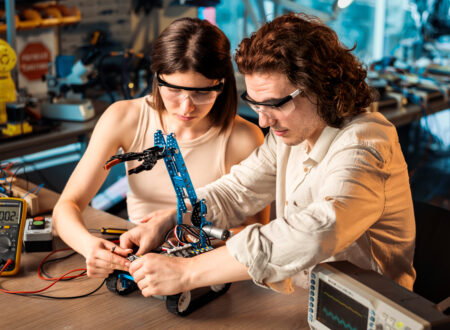
Reading about an exoskeleton in a textbook is one thing; building and testing one is another. Students who experience lab work with robotics kits, 3D printing, and sensor systems are far better equipped for the job market than those who only study theory.
Where Should Students Look to Study This Kind of Engineering?
This is where your choice of school and location becomes important. In particular, the capital of Chhattisgarh is silently establishing a solid foundation for modern mechanical education.
Exploring a List of Universities in Raipur, Chhattisgarh
Students looking for options usually start with a simple list of universities in Raipur, Chhattisgarh, that have excellent mechanical and robotics programs. When comparing institutions in Raipur, Chhattisgarh, consider not only their reputation but also their lab facilities, faculty expertise, and industry exposure.
What to Check Among Universities in Raipur
The speed of new technologies is not the same for all universities in Raipur. Students looking for colleges in Raipur can look out for several distinguishing signs of preparedness.
- Specialized robotics or mechatronics labs
- Faculty who publish or do research on wearable technology
- Partnerships with manufacturing or automation companies
- Modern workshops are not only traditional lathe and welding workshops
The universities in Raipur are primarily producing industry-ready graduates in automation-heavy sectors from the outset.
Private Universities in Raipur: A Faster Path to New Technology
Updating syllabus content in government institutions is usually a slow process. However, the private institutes in Raipur are more agile in catering to market trends such as exoskeletons and wearable robots.
Private universities in Raipur are more proactive in offering electives, workshops, and guest lectures on emerging technology. This flexibility is vital in a fast-changing domain such as industrial robotics.
If you are looking to study in private universities in Raipur rather than a public university, then make sure you ask them about the latest lab equipment and their recent industry tie-ups rather than just the brand.
What distinguishes the top universities in Raipur, Chhattisgarh?
Among the numerous universities in Raipur, a smaller group stands out as readily distinguishable. Some common features of top universities in Raipur, Chhattisgarh
- Track record of success in recruiting for engineering and technology firms
- Active research culture often displayed at conferences and in publications
- International academic partnerships that expose pupils to trends in international manufacturing
- Current, not years behind the industry. Modern infrastructure
Often, what makes the greatest colleges in Raipur, Chhattisgarh, is the seriousness with which an institution embraces hands-on, tech-led learning.
Why is Anjaneya University the best option in this field?
Raipur is also witnessing an increase in higher education alternatives like Anjaneya University.
The institution features a dedicated Faculty of Engineering, which houses Mechanical, Civil, Computer Science, Electrical and Electronics, and Telecommunications Engineering all under one roof.
What program is suitable for this kind of learning?
- B. Tech. in Mechanical Engineering with the potential to explore mechatronics and automation.
- M.Tech in Mechanical Engineering (Mechatronics and Tool Design) • Diploma in Mechanical Engineering (for quick and practical entry into industry)
- PhD Research Opportunities for Students
What’s Unique about the Experience?
- The program offers effective placement assistance by connecting students with recruiters in the engineering and technology fields.
- Partnerships with foreign universities provide students with international manufacturing processes
- At international conferences, like INCON, discussions are held on topics such as automation and smart manufacturing
- Modern laboratories for practical robotics and mechanical design
This program prepares students for the future of exoskeleton technology.
Anjaneya University is providing a blend of traditional mechanical studies with electives in automation and mechatronics to educate students with the proper skill set for today’s wearable robotics and smart manufacturing.
What happens to the mechanical workforce?
Exoskeletons are just one part of a broader transformation taking place across Indian manufacturing. Robots, sensors, and wearable gear are increasingly typical equipment on the manufacturing floor, not exceptional experiments.
The next wave will be mechanical engineers who understand both the old school of machine design and the new school of wearable robots. They will drive the next wave. The next wave will be driven by mechanical engineers who understand both the traditional principles of machine design and the modern concepts of wearable robots. The next generation of workers won’t have to pick between human labor and technical support. It will be a mix of both, and the bridge will be designed by engineers.
FAQs
Q1: Which is the best university in Raipur, Chhattisgarh, for mechanical engineering?
Look at schools having active robotics/automation programs. Visit the official websites of the colleges and compare their lab facilities and placement records.
Q2. What are the parameters to be compared for the institutes in Raipur with courses that have a robotics orientation?
Compare faculty expertise, laboratory facilities, industry tie-ups, frequency of curriculum changes as per new technology, etc.
Q3. Which private university in Raipur is best for new fields like wearable robotics?
While there are excellent government options, private colleges in Raipur are quicker to update their courses and invest more in contemporary labs, making them a good pick in new-age disciplines.
Q4: What is the difference between the top university in Raipur, Chhattisgarh, and others?
Strong placement records, international academic links, and an active research culture are the biggest characteristics separating top institutions in Raipur, Chhattisgarh, from average universities.