 By
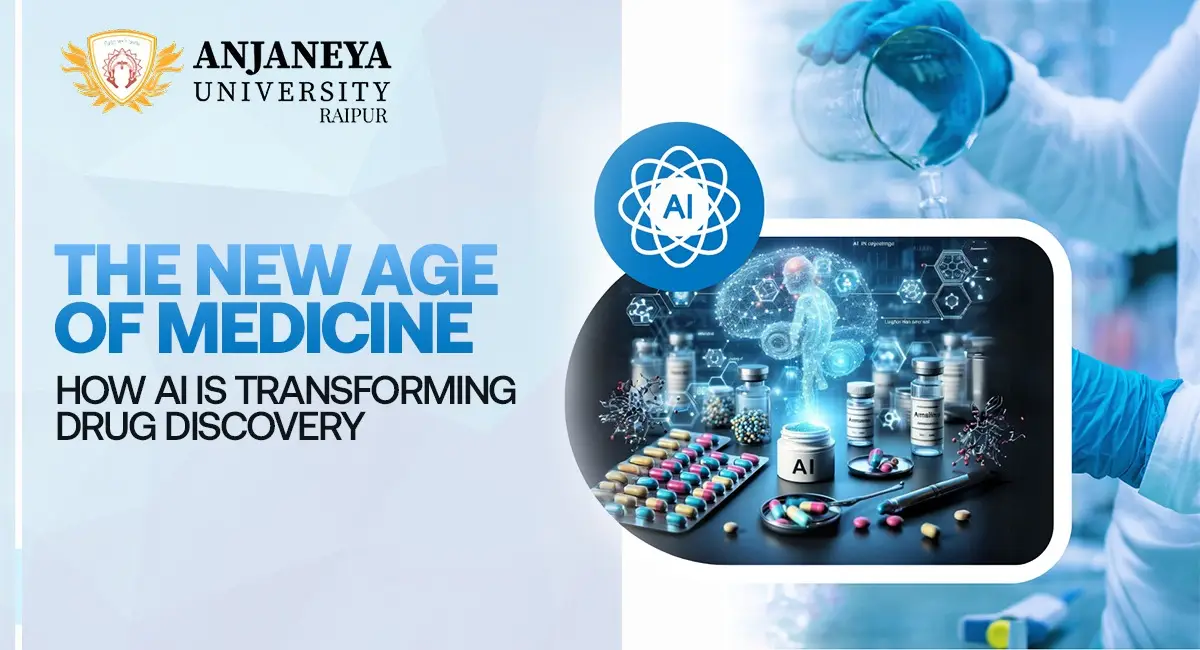
By In the rapidly evolving healthcare industry, the arrival of AI has set a new benchmark. As we stand on the edge of AI-driven technologies, it becomes imperative to understand the depth of the AI-driven approach. AI is not a tool, but it is a beacon of innovation that guides healthcare industries as well.
The role of AI in drug discovery goes beyond your imagination. AI skills are helping scientists to overcome challenges. It can identify potential drug candidates, predict treatment outcomes, and revolutionize drug discovery. If you want to step into this game-changing industry, you can take admission in d pharmacy. Let’s explore this blog to know every guideline!
Understanding AI in Drug Discovery
AI is transforming how new medicines are discovered and tested. Instead of depending on traditional lab experiments, pharmaceutical research centers are using an AI approach to improve decision-making skills.
What does AI mean in pharmaceutical research?
In healthcare research, AI refers to the use of machine learning, advanced algorithms, and deep learning. These tools are used to analyze biological and chemical data. Nowadays, major pharma companies are integrating AI-driven skills to accelerate drug development.
However, AI acts as a highly intelligent research assistant that can scan millions of data points in seconds with ease. So, it is necessary to choose reliable D.Pharm colleges that offer research facilities. At Anjaneya University, students will get;
- Under the guidance, students can publish research papers, attend conferences, and present innovations.
- Students can participate in drug development, novel delivery systems, and healthcare innovation projects.
- Regular organization of National and International conferences, seminars, and workshops supported by reputed academic and scientific bodies such as CCOST, AERB, NCPSL, etc.
- Active research ecosystem with funded projects, publications, patents, and startup support.
Difference between rule-based models and learning systems
Rule-based models (Traditional methods)
- It cannot be enhanced automatically from new data.
- It operates on predefined rules.
- This model is limited to what researchers explicitly program.
Learning Systems (Modern AI algorithms)
- An AI-driven approach can help you identify patterns directly from data.
- Usage of different algorithms.
- It is used to enhance performance. For example, AI can analyze thousands of cancer molecular structures without predefined rules.
How data fuels AI-driven drug development
Data quality control is necessary for the ethical handling of patient information. However, incomplete datasets can lead to mistaken predictions.
- Pattern recognition – AI-driven approach to connections between molecules and biological responses.
- Faster screening – AI tools can analyze millions of compounds virtually.
- Prediction accuracy – AI-oriented skills are used to enhance reliability.
Are you ready to step into the world of pharmacy after 12th grade? You can take admission in d pharmacy at Anjaneya University. Have you checked the USP for Pharmacy of this college? Let’s explore;
What Makes Anjaneya University Great
Academic Excellence
- Well-maintained machine rooms support research and analytical testing with top-notch quality equipment.
- Students can access the advanced analytical and research instruments, including dissolution test apparatus, HPLC, digital balances, UV- Spectroscopy, pH meter, and other modern quality-evaluation tools.
- All laboratories are fully equipped for Pharmacology and Pharmaceutical Chemistry.
- This college includes a Pilot-scale pharmaceutical manufacturing facility with a tablet punching machine.
Faculty Excellence
- AI-based courses are offered by highly qualified, experienced, and research-oriented teachers. They are committed to offering the industry trends academic sessions.
- Students get personalized mentoring, academic guidance, and professional skill development programs.
- Implementation of outcome-based education, experiential learning, and continuous assessment methods.
Industrial Connections
- The strong training and placement cell offers career counselling, campus recruitment drives, and aptitude preparation.
- This college has an active MoUs with pharmaceutical industries, clinical research organizations, hospitals, and pharmacovigilance centres for training, internships, and collaborative learning.
- Students will get training for formulation development, quality assurance, quality control, regulatory affairs, and clinical pharmacy practice.
Modern Infrastructures
- Digital library, e-learning resources, modern smart classrooms, and a safe campus attract fresh minds.
- This college offers regular value-added courses, soft-skill workshops, and entrepreneurship development programs.
- The active placement cell ensures internships, industry exposure, and employment opportunities.
How AI Is Transforming Drug Discovery at the Molecular Level
Predicting protein structures
Proteins are the biological machines of our body. Scientists are designing drugs by using a protein’s 3D structure. At present, AI systems like DeepMind’s AlphaFold predict protein structure with accuracy.
- AI systems reveal hidden binding pockets.
- It can accelerate target validation.
- You don’t need to wait for lab results as AI systems enable structure-based drug design.
Identifying drug–target interactions faster
- AI predicts how strongly a molecule binds to a protein.
- It simulates molecular docking within seconds. Manually this process takes long days.
- It identifies off-target interactions that may cause side effects.
Virtual screening of millions of compounds
- AI can simulate millions of molecules computationally.
- Within a single day, AI can scan massive chemical libraries.
How AI Is Transforming Drug Discovery in Early-Stage Research
Target identification and validation
Before producing the drugs, researchers identify the right biological target. By incorporating an AI-driven approach, clinical success will be enhanced.
In that case, AI helps;
- To analyze large-scale genomic datasets.
- To identify disease-driving genes by using pattern recognition.
- Map protein-protein interaction networks.
Biomarker discovery
Biomarkers are biological indicators, i.e., proteins, metabolites, and genes. These indicate disease presence, treatment responses, and others. By incorporating AI, pharmacists get a lot of benefits. However, the AI-powered biomarker supports the rise of precision medicine.
- An AI-driven approach can detect hidden patterns in datasets.
- It predicts treatment response before therapy designs.
- It identifies molecular signatures associated with disease subtypes.
Repurposing existing drugs using AI models
Developing a medicine from scratch takes almost 10-15 years. But, AI-driven skills progress by recognizing the new uses for existing drugs.
- AI analyzes drug-target interaction databases.
- It predicts alternative therapeutic applications.
- Before clinical testing, it simulates outcomes.
- By incorporating AI, costs will be low.
How AI Is Transforming Drug Discovery through Machine Learning Models
Supervised vs unsupervised learning in pharma
| Supervised learning | Unsupervised learning |
| Models are trained on labeled data. | Model works with unlabeled data. |
| The system learns from input-output pairs. | The system learns from hidden patterns. |
| It is used to predict drug toxicity. | It is used to identify disease subtypes. |
Deep learning for chemical property prediction
Deep learning is a part of machine learning that plays a major role in drug discovery.
- It predicts chemical and physical properties.
- It analyzes molecular graphics.
- It estimates ADMET (Metabolism, Absorption, Distribution, Excretion, and Toxicity)
Generative AI for novel molecule design
Generative AI can create new molecules from scratch.
- Generative AI can design molecules with specific desired properties.
- It optimizes compounds for safety.
- It explores chemical space beyond known libraries.

How AI Is Transforming Drug Discovery in Clinical Trials
Smarter patient selection
For trial success, it is crucial to recruit the right patient. If participants don’t match the drug’s target profile, results can be negative.
- By using Natural Language Processing, AI matches patients to trials faster.
- AI predicts which individuals are more likely to respond to treatment.
Predicting trial outcomes and risks
Clinical trials often fail due to safety issues. But, AI models predict the risks before or during trials.
- AI identifies potential adverse effects early.
- It detects early warning signals from real-time data.
- It simulates trial scenarios to test different designs.
Reducing trial timelines and costs
Clinical trials take a long time and billions of dollars as well. But an AI-driven approach can streamline processes.
- AI can speed up regulatory documentation preparation.
- It enables decentralized trials.
- In data processing, it can reduce manual errors.
How AI Is Transforming Drug Discovery in Safety and Toxicity Testing
Predicting adverse effects before lab testing
Toxicity was discovered through in-cell-based and animal experiments. Also, it can often be produced in late development.
- AI predicts organ-specific toxicity.
- It estimates drug-drug interaction risks.
- AI analyzes chemical structure patterns linked to know toxic outcomes.
Reducing animal testing through simulations
Animal testing has long been part of a safety evaluation. But this process is expensive and time-consuming. An AI-driven approach is used for virtual organ simulations.
Improving success rates in later trial phases
Sometimes drugs fail in trials due to unexpected toxicity. But, AI enhances success by;
- Predicting patient-specific adverse reactions.
- Ongoing monitoring of safety signals during trials.
- Filtering unsafe candidates at first.
Real-World Examples of AI in Drug Discovery
AI-driven breakthroughs during pandemic research
During the COVID-19 era, AI speeds up research efforts.
- AI models analyzed the SARS-Co V-2 genome within a few days of publication.
- It predicts viral protein structures and drug-binding sites.
- AI-supported models are reducing experimental trial-and-error. It allows researchers to prioritize therapeutic strategies rapidly.
Pharma companies partnering with AI startups
Major pharmaceutical companies are integrating with AI startups to strengthen pipelines. Reputed pharma companies are connecting with AI-driven companies for innovation.
- The Atomwise company applies deep learning for structure-based discovery.
- Pfizer has a partnership with AI-driven research firms.
- Novartis is investing in data science platforms.
Challenges of Using AI in Drug Discovery
Data quality and bias
Key challenges
- Experimental difference – Differences in lab conditions and measurement standards.
- Partial datasets – Inconsistent records and missing experimental values.
- Data imbalance – Certain populations and disease types.
Regulatory and ethical concerns
Key challenges
- Model performance metrics.
- AI-generated predictions.
- Handling evolving models.
Explainability and trust in AI decisions
Many advanced AI systems produce predictions without clearly explaining how outcomes are reached.
- Scientists need to understand why a molecule is recognized as toxic.
- Regulators require transparent reasoning for approval.
The Future of Drug Discovery in an AI-Driven World
Fully autonomous drug discovery pipelines
The future of drug discovery may include AI designs, tests, and optimization of molecules.
- AI recognizes disease targets from genomic data.
- AI generative models design optimized molecules.
- Real-time feedback loops refine predictions.
Personalized medicine powered by AI
Future drug discovery will tailor the drug according to the individual patients.
- An AI-driven approach designs targeted therapies for rare changes.
- It analyzes biomarker data.
- It optimizes dosage based on metabolic modeling.
The evolving role of human researchers
As AI becomes more upgraded, the role of researchers will evolve rather than disappear. Researchers need to take responsibility,
- It designs experimental validation studies.
- It offers biological intuitions and contextual reasoning.
- An AI-driven approach is used to interpret AI-generated insights.
Conclusion: How AI Is Transforming Drug Discovery for the Better
In conclusion, AI is upgrading the drug industry by making the process faster and cost-effective. It becomes a standard tool in healthcare industries that enables personalized treatment strategies.
Many pharmaceutical companies are investing heavily in AI. Also, they make partnerships with different AI companies to transform their business. If you are planning to take admission in d pharmacy, choose a reliable college.
Anjaneya University can be your first choice due to its proven placement record in pharmaceutical industries, hospitals, and clinical research sectors.